
The Unsolved Case Files of Eli Mercer
(by Wiley James)
17 mysteries. One relentless mind.
Time erases details. Headlines distort facts. Witnesses forget—or embellish. Yet the truth of an unsolved crime still lingers, waiting for someone to cut through the noise.
Enter Eli Mercer—a singular detective with an uncanny ability to strip a case back to its raw bones. Guided by “the Method,” Eli shows readers how to filter away media sensationalism, police missteps, and unreliable accounts until only the core evidence remains.
From the Black Dahlia to the Zodiac Killer, the Sodder Children, even the cultural panic of War of the Worlds, Eli walks you through the mysteries that have haunted history and offers his Most Likely conclusion.
These aren’t final verdicts. They’re windows—letting you glimpse what most probably happened when the world wasn’t watching.


Eli Mercer: A Voice Unlike Any Other
Eli Mercer isn’t just investigating the past, he’s narrating it with a mix of razor‑sharp analysis and the gritty intuition of a detective who’s seen too much. Each case is both a puzzle and a performance:
He’ll show you how headlines get it wrong, how the scene itself whispers the truth, and how one overlooked detail can flip the story upside‑down.
Eli walks you into the fog of mystery, peels it back with “the Method,” and then, in that gravel‑on‑velvet voice of his, drops the Most Likely answer on the table. Not a final verdict, because the past keeps its secrets—but a conclusion you won’t be able to forget.
“I don’t discount the supernatural. But if it wants a place in my journal, it must show itself like every other piece of evidence—observable, verifiable, capable of being tested. Ghosts don’t get a free pass.” — Eli Mercer
The Flannan Isles Case
"I can go back. Not with machines or fairy tricks, but with the exacting attention that bends time: the present loosens, the mind furnishes missing moments with the facts left behind. When I close my eyes on a place, the past layers itself over the present like transparent film. It's not magic. It's reconstruction, slow, forensic, and cruelly honest."
Eli Mercer
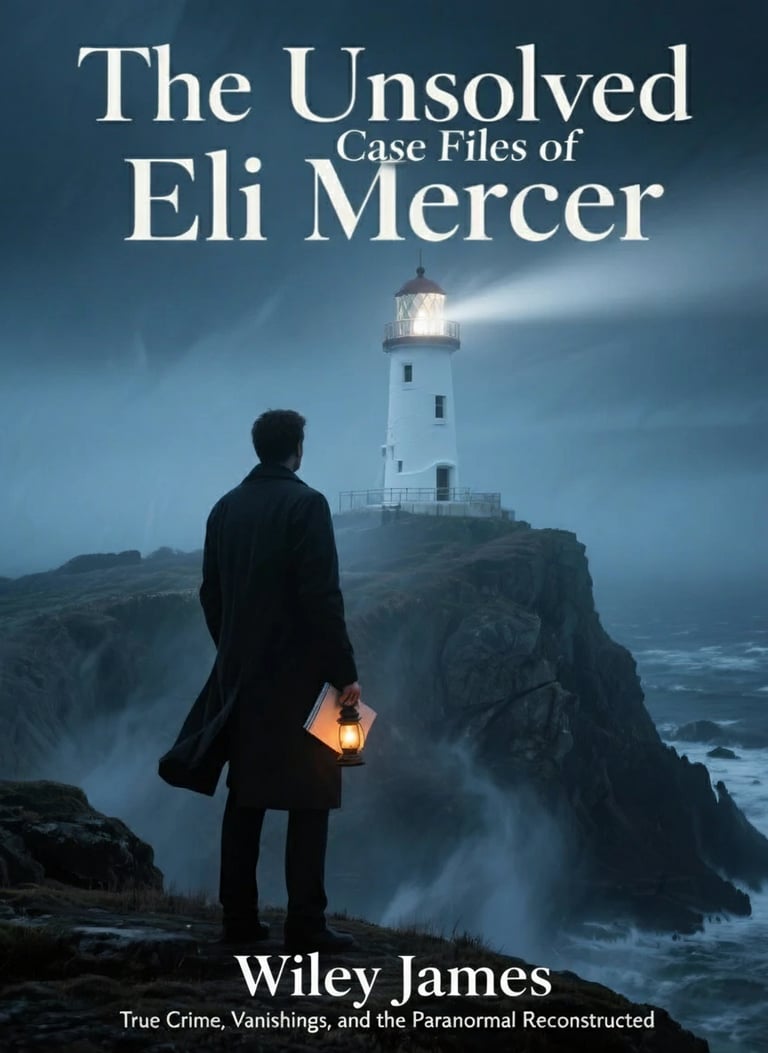
Get The Book


The Unsolved Case Files of Eli Mercer


Eli has investigated over 200+ famous unsolved cases. Ask him about a case that has perplexed you.
“Get Involved”
Have a crime you’d like Eli Mercer to investigate? Or a story you want to see reimagined?
👉 [📩 Suggest a Story]
If you would like to support my work, you can do so at
ELI MERCER CASE FILE PREVIEW
Thames Torso Murders
A Cold Case Investigation
Case Number: EM-1887-003
Original Investigation: Metropolitan Police, H Division
Date Opened: October 15, 1887
Status: Unsolved
Investigator: Detective Eli Mercer (Reconstruction, 2024)
CASE OVERVIEW
The autumn of 1887 brought London more than its usual fog. On the morning of October 15th, a mudlark working the Thames foreshore near Whitmore Street discovered what would become known as the first of the Thames Torso Murders—a human torso, expertly dismembered, wrapped in oilcloth that bore the faint impression of a Bermondsey tannery mark.
I have spent the better part of eighteen months reconstructing this case, not because I believed I could resurrect the dead or summon witnesses from their graves, but because the truth has a way of settling into the spaces between what was recorded and what was forgotten. Reconstruction is not time travel; it's attention that has learned to wait.
The official files, yellowed and brittle in the Metropolitan Police archives, tell a story of bureaucratic frustration. Three separate discoveries. Three different investigating officers. No coordination. No resolution. But beneath the administrative failures lies something more deliberate—a killer who understood both anatomy and geography, who knew the Thames well enough to predict where the current would carry his work.
This was not passion. This was precision.
CHRONOLOGY & EVIDENCE
October 15, 1887 - First Discovery
Thomas Hartwell, mudlark, age 14, discovered a human torso wrapped in oilcloth approximately 200 yards east of Whitmore Street Pier. The torso belonged to a female, aged 25-35, with evidence of recent childbirth. The dismemberment showed surgical precision—clean cuts through joints, minimal bone scoring. Dr. Edmund Blackwell, police surgeon, noted the killer possessed "considerable anatomical knowledge."
The oilcloth bore a partial maker's mark: "...MOND TANN..." Later identified as likely originating from Bermondsey Tannery, though the company's records from 1887 were destroyed in a fire in 1923.
October 28, 1887 - Second Discovery
A left arm and hand, female, discovered by dock workers near London Bridge. The hand showed calluses consistent with domestic work—specifically, the distinctive wear pattern of a laundress. A thin gold band remained on the ring finger, inscribed with "E.M. - Forever Thine - 1885."
Inspector Frederick Moss, investigating this second find, failed to connect it to the Whitmore Street torso despite the obvious similarities in dismemberment technique.
November 12, 1887 - Third Discovery
The head, recovered by a Thames Police constable near Rotherhithe. Brown hair, brown eyes, a small scar above the left eyebrow. Most significantly, the victim's teeth showed the distinctive work of a particular dental technique—gold wire reinforcement—practiced by fewer than a dozen dentists in London at the time.
Detective Sergeant William Crane, assigned to this discovery, did make the connection to the previous finds. His notes, preserved in the file, show a methodical mind: "Same hand. Same blade. Same knowledge. We are hunting a surgeon or a butcher with surgical training."
But Crane was transferred to another division before he could pursue the investigation further.
WITNESS STATEMENTS (EXCERPTED)
Thomas Hartwell, Mudlark (Age 14)
Statement taken October 15, 1887
"I was working the foreshore, looking for coal and copper, when I seen the bundle. Thought it might be clothes, something I could sell. But when I pulled it from the mud... God help me, sir, I ain't never seen nothing like it. Wrapped tight it was, like someone took care with it. Not thrown away careless-like. Placed."
Mrs. Agnes Whitmore, Laundress, Whitmore Street
Statement taken October 16, 1887
"There was a girl came to me for work, maybe six weeks past. Said her name was Emma. Emma Morrison, I think. Had a baby with her, tiny thing. I told her I couldn't take her on—too many mouths to feed already. But she had good hands, strong hands. The kind that knew work. She asked particular about the hours, about when the street would be quiet. Said she had reasons for keeping to herself."
Dr. Cornelius Ashford, Dentist, Harley Street
Statement taken November 15, 1887
"The dental work is mine, without question. The gold wire technique—I learned it in Vienna, and I am one of perhaps eight practitioners in London who employ it. The patient was a young woman, Emma Morrison. She came to me in July of this year, paid in advance, cash. Said she was going into service and wanted her teeth properly maintained. I remember her because she asked specifically about the durability of the work—whether it would last 'no matter what happened to her.' An odd phrasing that stayed with me."
ELI'S ANALYSIS
The official investigation failed because it treated three discoveries as three separate crimes. But the evidence speaks to a single perpetrator with a specific methodology and, more importantly, a specific relationship to his victim.
Emma Morrison—for that appears to have been her name—was not a random victim. The care taken with the dismemberment, the precision of the cuts, the deliberate placement of the remains suggest someone who knew her, who perhaps even cared for her in some twisted fashion. This was not the work of Jack the Ripper, despite the temporal proximity. The Ripper's victims were left where they fell, displayed in their violation. Emma Morrison was carefully parceled out, as if the killer could not bear to dispose of her all at once.
The gold ring inscription—"E.M. - Forever Thine - 1885"—suggests a relationship that began two years before her death. The recent childbirth evidence indicates this relationship produced a child. Yet no missing person report was ever filed for Emma Morrison, and no infant was reported abandoned or found dead in the relevant timeframe.
This suggests the killer was someone with authority over Emma's life—someone whose word would be accepted if he claimed she had simply "moved on" or "returned to family." In 1887 London, this points to three possibilities: a husband, an employer, or a medical professional who had been treating her.
The anatomical precision eliminates the husband unless he possessed surgical training. The employer theory fails because Mrs. Whitmore's statement indicates Emma was seeking work, not leaving it. This leaves us with a medical professional—someone who knew Emma as a patient, who had access to surgical instruments, and who possessed the anatomical knowledge evident in the dismemberment.
The dental work provides our strongest lead. Dr. Ashford's statement reveals Emma paid in advance and spoke of her teeth needing to last "no matter what happened to her." This suggests foreknowledge of danger, possibly even of her own death.
But here the trail grows cold. Dr. Ashford's patient records from 1887 were destroyed in the Blitz. The Bermondsey Tannery records are gone. The investigating officers are long dead, and their personal notes, if any existed, have vanished into the great forgetting that swallows most police work.
MOST LIKELY CONCLUSION
Emma Morrison was killed by someone she knew and trusted—most likely a medical professional who had been treating her, possibly for complications related to her recent childbirth. The killer possessed surgical skills and anatomical knowledge, had access to quality oilcloth (suggesting financial means), and was familiar enough with the Thames to predict tidal patterns and current flows.
The relationship between killer and victim was intimate but not romantic—the care taken with the dismemberment suggests guilt or remorse, but the methodical disposal indicates premeditation. Emma Morrison likely discovered something about her killer that made her dangerous to him, or she may have been threatening to expose him for some professional misconduct.
The child born to Emma Morrison in 1887 either died with her or was disposed of separately. Given the killer's medical background, it's possible the child was the source of the conflict—perhaps born with defects that the killer, as a medical professional, felt compelled to hide.
The case remains unsolved not because the evidence was insufficient, but because the investigation was fragmented and the social structures of 1887 London protected men of medical standing from serious scrutiny. Emma Morrison was a working-class woman with no family to advocate for her. Her killer was likely a gentleman whose word carried weight.
In the end, Emma Morrison became what she feared most—forgotten. But the fragments of her story, scattered like her remains along the Thames, still speak to those willing to listen. The truth doesn't always set us free, but it does, occasionally, set the record straight.
ABOUT THE INVESTIGATOR
Detective Eli Mercer specializes in cold case reconstruction, applying modern analytical techniques to historical mysteries. His methodology focuses on evidence over speculation, facts over sensationalism. "The dead deserve better than our theories," Mercer says. "They deserve our attention."
This case file is excerpted from Thames Torso Murders and Other Cold Cases, part of Eli Mercer's ongoing investigation into London's forgotten crimes. For more case files and investigative insights, check out the book The Unsolved Case Files of Eli Mercer on Kindle or Gumroad here: Book
"Reconstruction is not time travel; it's attention that has learned to wait."
— Detective Eli Mercer
@2025 Wiley James all rights reserved
Connect
Subscribe to WordWorx Gum Road community.
WordWorx Media © 2025. All rights reserved.
This site is still being built. Socials coming soon.
WordWorx Media is the self‑publishing entity of Wiley James, author of Alternate Endings and The Unsolved Case Files of Eli Mercer.